Hey there! As a supplier of Alumina Ceramic Foam Filters, I often get asked about the difference between Alumina Ceramic Foam Filters and ceramic honeycomb filters. So, I thought I’d take a few minutes to break it down for you. Alumina Ceramic Foam Filter

Let’s start with the basics. First off, what are these filters used for? Both Alumina Ceramic Foam Filters and ceramic honeycomb filters are widely used in the metal casting industry. They’re all about getting rid of impurities and making the final metal product better in quality. But the way they do this job is where things start to get different.
Structure: The First Clue
The most obvious difference between the two kinds of filters lies in their structure. Alumina Ceramic Foam Filters, as the name suggests, have a foam – like structure. Picture a sponge, but made of alumina ceramic. It’s got a network of interconnected pores that are kind of random in size and distribution. These pores can trap small impurities as molten metal flows through them.
On the other hand, ceramic honeycomb filters have a structured, honeycomb – like design. They’re made up of a large number of parallel channels separated by thin walls. The channels are usually of a uniform size and shape, kind of like a bunch of tiny straws lined up together. This structure gives the honeycomb filter a very consistent and predictable flow path for the molten metal.
Filtration Mechanisms
Now, let’s talk about how they actually filter the molten metal. Alumina Ceramic Foam Filters rely on a combination of mechanical and adsorption – based filtration. The porous structure acts like a sieve. When molten metal flows through the foam, larger impurities simply can’t pass through the small pores and get stuck. At the same time, the surface of the alumina ceramic can adsorb some smaller particles, like those that are attracted to the ceramic material due to electrostatic forces or chemical reactions.
Ceramic honeycomb filters, however, mainly work through a mechanical filtration process. The parallel channels act as a barrier. As the molten metal moves through these channels, any impurities that are larger than the channel size will be blocked. The thin walls of the honeycomb also provide some surface area for the capture of small particles, but it’s not as significant as the mechanical blocking effect.
Flow Characteristics
Flow characteristics are also quite different between the two. Alumina Ceramic Foam Filters offer a relatively high resistance to flow. Because the pores are randomly arranged, the molten metal has to take a tortuous path through the filter. This can be a good thing in some cases, as it gives the metal more time to interact with the filter and for the impurities to be removed. But it also means that you need a higher pressure to push the metal through the filter.
Ceramic honeycomb filters, on the other hand, have a much lower flow resistance. The straight channels allow the molten metal to flow through more easily, with less pressure drop. This is great for applications where you need a high flow rate, like in large – scale casting operations.
Filtration Efficiency
The filtration efficiency is a key factor when choosing a filter. Alumina Ceramic Foam Filters are really good at filtering out a wide range of particle sizes. Their random pore structure can trap both large and small impurities effectively. They’re especially good at capturing those hard – to – catch small particles because of the adsorption effect on the ceramic surface.
Ceramic honeycomb filters excel at filtering out larger particles. The consistent channel size can ensure that any particles larger than the channel diameter are blocked. However, they may not be as effective at capturing very small particles as the Alumina Ceramic Foam Filters, especially if those small particles can pass through the channels without getting stuck.
Thermal and Mechanical Properties
Both types of filters need to be able to withstand the high temperatures of molten metal. Alumina Ceramic Foam Filters are known for their excellent thermal shock resistance. The foam structure can absorb some of the thermal stress caused by the sudden change in temperature when the molten metal hits the filter. They also have good mechanical strength despite their porous nature, which means they can hold up during the metal – casting process.
Ceramic honeycomb filters are also thermally stable but may be more prone to thermal shock in some cases. Their rigid honeycomb structure doesn’t have as much flexibility as the foam to absorb thermal stress. In terms of mechanical strength, the thin walls of the honeycomb can be a bit more delicate compared to the overall structure of the foam filter. So, they might need a bit more careful handling during installation and use.
Application Scenarios
Alumina Ceramic Foam Filters are a popular choice for a wide variety of casting applications. They’re commonly used in the casting of aluminum, brass, and other non – ferrous metals. They’re great for applications where you need high – quality castings with a low level of impurities. For example, in the automotive industry, where parts need to be of top – notch quality, Alumina Ceramic Foam Filters are often used to ensure the metal castings are free from defects.
Ceramic honeycomb filters are often used in applications where a high flow rate is required. They’re commonly seen in large – scale foundries, such as those producing steel castings. The low flow resistance of the honeycomb structure allows a large volume of molten metal to be filtered quickly, which is essential for mass – production scenarios.
Cost Considerations
Cost is always an important factor in any business decision. Generally speaking, Alumina Ceramic Foam Filters may be a bit more cost – effective for smaller – scale operations or when you need high – quality filtration. The manufacturing process for foam filters allows for relatively simple production, which can keep the costs down.
Ceramic honeycomb filters, on the other hand, may be more expensive due to their more complex manufacturing process. The precision required to create the uniform honeycomb structure adds to the production cost. However, in large – scale operations where the high flow rate justifies the cost, the investment in honeycomb filters can pay off.
Conclusion
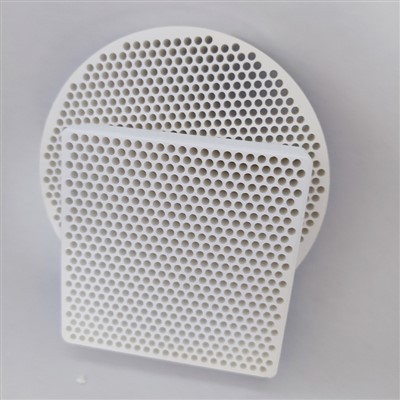
So, as you can see, there are quite a few differences between Alumina Ceramic Foam Filters and ceramic honeycomb filters. Each type has its own unique advantages and is better suited for different applications. Whether you’re looking for high – quality filtration, a high flow rate, or cost – effectiveness, you need to weigh these factors carefully when choosing the right filter for your metal – casting process.
Alumina Ceramic Foam Filter If you’re in the market for Alumina Ceramic Foam Filters, I’d love to have a chat with you. We can discuss your specific needs and see how our filters can fit into your production process. Whether you’re working on a small – scale project or running a large foundry, I’m here to help you make the best choice for your business. Just reach out, and let’s start the conversation about how we can work together to improve your casting quality!
References
- Abdullah, M. I., & Reddy, C. P. (2018). Metal Casting Technology: Science, Process, and Practice. Springer.
- Cárcel, A., & Barrales – Monereo, M. (Eds.). (2016). Advances in Solidification Processes. Woodhead Publishing.
Shanxi Dingtai Yinrui Filter Manufacturing Co., Ltd.
As one of the most professional alumina ceramic foam filter manufacturers and suppliers in China, we’re featured by quality products and good service. Please feel free to buy high-grade alumina ceramic foam filter made in China here from our factory. Contact us for more details.
Address: Plant 1-2, No.3 Xuhu Business and Trade Industrial Park, Houma Economic Development Zone, Linfen, Shanxi, China
E-mail: tina@dtcastingfilters.com
WebSite: https://www.dingtaifilter.com/
